How to Write a UK CV: The Complete Step-by-Step Guide
Are you applying for jobs in the United Kingdom but unsure how to write a UK CV that employers will notice?
Whether you're a recent graduate, an international job seeker, someone looking for your first job, or an experienced professional changing careers, having a well-written CV is one of the most important steps towards getting hired.
Your CV is often the first impression you make on a potential employer. A clear, professional and well-structured CV can help you stand out from other applicants and increase your chances of being invited to an interview.
However, writing a CV for the UK job market can be confusing, especially if you're unfamiliar with British recruitment expectations.
In this complete guide, you'll learn how to write a UK CV, including the correct UK CV format, what information to include, common mistakes to avoid, and practical CV examples.
What Is a UK CV?
A CV, short for Curriculum Vitae, is a document that summarises your professional experience, education, qualifications, skills and achievements.
In the United Kingdom, employers typically request a CV when you apply for jobs.
Unlike a cover letter, which explains why you're interested in a particular position, your CV provides an overview of your professional background and suitability for the role.
A standard UK CV usually includes:
- Your name and contact information
- A professional profile or personal statement
- Relevant skills
- Employment history
- Educational qualifications
- Professional certifications and training
- Additional relevant information
The purpose of your CV is simple: convince an employer that you have the skills, experience and potential to succeed in the job.
What Is the Correct UK CV Format?
One of the most common questions job seekers ask is: What is the standard UK CV format?
For most job applications in the UK, a professional CV should be approximately one to two A4 pages long.
Experienced professionals may occasionally need additional space, particularly for specialist, academic or research positions.
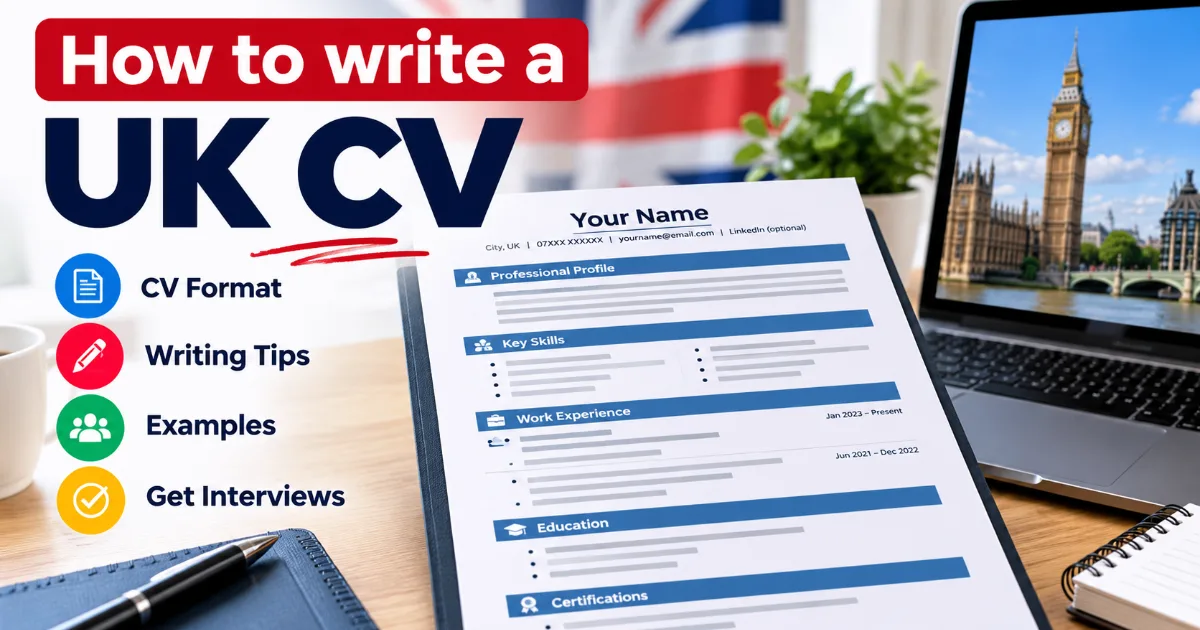
Here is the recommended structure for a UK CV:
1. Personal Details
Your personal details should appear at the top of your CV.
Include:
- Full name
- Mobile phone number
- Professional email address
- Town or city and country
- LinkedIn profile (optional)
- Portfolio or professional website (if relevant)
Example:
James Williams
Manchester, United Kingdom
Email: james.williams@email.com
Phone: 07XXX XXXXXX
LinkedIn: linkedin.com/in/jameswilliams
You generally do not need to include your full home address.
Personal Information You Should Avoid Including
Unlike CVs in some other countries, a UK CV does not normally require:
- Your photograph
- Date of birth
- Marital status
- Gender
- Religion
- Nationality
- Passport number
These details are generally unnecessary for employers assessing your suitability for a role.
If an employer needs information about your right to work in the UK, they may ask for it separately during the recruitment process.
2. Write a Strong CV Personal Statement
Your personal statement, sometimes called a professional summary or CV profile, is a short introduction at the beginning of your CV.
It should explain who you are professionally, what experience or strengths you bring, and the type of role you're seeking.
A good UK CV personal statement is usually around 3–5 sentences.
Example of a Personal Statement for an Experienced Professional
"Results-driven Marketing Executive with over five years of experience developing digital marketing campaigns, managing advertising budgets and improving customer acquisition. Skilled in Google Ads, Meta Ads, SEO and marketing analytics. Proven ability to increase lead generation and improve campaign performance. Seeking a challenging marketing position within a growing UK organisation."
Example of a Personal Statement for Someone With No Experience
"Motivated and reliable individual with strong communication, organisational and teamwork skills. Eager to begin a professional career and contribute positively to a growing organisation. Quick to learn new systems, comfortable working with others and committed to delivering excellent customer service."
Tips for Writing a Good Personal Statement
Keep your personal statement relevant to the position you're applying for.
Avoid generic descriptions such as "I am hardworking and passionate" without explaining what makes you suitable for the role.
Instead, highlight your relevant skills, qualifications and achievements.
SEO tip for job seekers: If the job advert asks for customer service experience, project management skills or proficiency in Microsoft Excel, include those terms naturally in your CV when they accurately describe your abilities.
3. Include Your Employment History
Your employment history is one of the most important sections of your UK CV.
Most UK employers prefer work experience to be listed in reverse chronological order, meaning your most recent job appears first.
For each position, include:
- Job title
- Company name
- Location (optional)
- Employment dates
- Main responsibilities
- Relevant achievements
UK CV Work Experience Example
Digital Marketing Executive
ABC Marketing Agency, London
January 2023 – Present
- Managed Google Ads and Facebook advertising campaigns across multiple client accounts.
- Increased website enquiries by 35% through targeted digital marketing strategies.
- Developed SEO content that improved organic website traffic.
- Monitored campaign performance using Google Analytics and other reporting tools.
- Collaborated with sales teams to improve lead conversion rates.
How to Describe Your Work Experience Effectively
Avoid simply listing what you were responsible for.
Instead, explain the impact of your work.
Weak example:
"Responsible for social media accounts."
Better example:
"Managed five social media accounts, increasing audience engagement by 40% over six months."
Using numbers and measurable achievements helps employers understand the value you can bring to their organisation.
If you don't have exact performance figures, describe the improvements, processes or contributions you made without inventing numbers.
4. Add Your Education and Qualifications
The education section of your CV should include your relevant academic qualifications.
Start with your most recent or highest qualification.
UK CV Education Example
Bachelor of Science (BSc) in Business Management
University of Birmingham
2019–2022
A-Levels
Manchester College
2017–2019
For experienced professionals, the education section can be relatively short.
However, if you're a recent graduate or have limited work experience, you may want to include relevant coursework, academic projects, placements or achievements.
How to Include International Qualifications on a UK CV
If you studied outside the United Kingdom, you can still include your qualifications.
For example:
Bachelor of Science in Computer Science
University of Lagos, Nigeria
2018–2022
You do not need to remove an international qualification simply because it was obtained outside the UK.
If necessary, you can use UK ENIC to obtain information about how an international qualification compares with UK qualifications.
This can be particularly helpful when applying for roles that specify certain educational requirements.
5. Highlight Your Relevant Skills
Employers want to know whether you have the skills required to perform the job.
Your skills section should be tailored to the position you're applying for.
There are two main categories of skills.
Hard Skills
Hard skills are specific abilities acquired through education, training or work experience.
Examples include:
- Microsoft Excel
- Data analysis
- Project management
- Digital marketing
- Accounting software
- Customer relationship management (CRM)
- Programming
- Graphic design
- Search engine optimisation (SEO)
Soft Skills
Soft skills relate to how you work and interact with other people.
Examples include:
- Communication
- Teamwork
- Problem-solving
- Time management
- Leadership
- Adaptability
- Organisation
- Customer service
Example of a UK CV Skills Section
Key Skills
- Customer relationship management
- Microsoft Office (Word, Excel and PowerPoint)
- Data entry and reporting
- Excellent written and verbal communication
- Time management and organisation
- Problem-solving and teamwork
Avoid including every skill you can think of.
Focus on the skills most relevant to the vacancy and provide evidence of them in your employment history where possible.
6. Include Professional Certifications and Training
If you have completed professional courses or obtained industry-recognised certifications, consider including them on your CV.
Examples include:
- Google Analytics Certification
- PRINCE2 Foundation or Practitioner
- AAT Accounting Qualifications
- CIPD Qualifications
- Microsoft Certifications
- First Aid Training
- Safeguarding Training
- Health and Safety Certifications
This section is especially useful when applying for specialist positions or changing careers.
Only include qualifications you genuinely hold, and make sure certification details are accurate.
7. Add Additional Information Where Relevant
Depending on the role, you may include additional sections such as:
Volunteering: Useful for demonstrating transferable skills, particularly when you have limited paid work experience.
Languages: Helpful for customer-facing, international or multilingual positions.
Projects: Particularly valuable for technology, marketing, engineering and creative roles.
Professional memberships: Relevant to industries such as accounting, engineering, HR and healthcare.
Portfolio: Useful for designers, writers, developers, photographers and marketing professionals.
You do not need to include all these sections. Choose the information that strengthens your application.
UK CV Example: A Simple Professional CV Template
Below is an example of a UK CV layout you can adapt for your own job applications.
JAMES WILLIAMS
Manchester, United Kingdom
07XXX XXXXXX | james.williams@email.com
Personal Profile
Organised and customer-focused professional with three years of experience in administration and customer service. Skilled in managing enquiries, maintaining accurate records and supporting daily office operations. Confident using Microsoft Office and CRM systems. Seeking an administrative position within a professional UK organisation.
Key Skills
- Customer service and communication
- Microsoft Word, Excel and Outlook
- Administrative support
- Data entry and record management
- Appointment scheduling
- Time management
- Teamwork and problem-solving
Work Experience
Administrative Assistant
Bright Solutions Ltd, Manchester
March 2023 – Present
- Respond to customer enquiries through email and telephone.
- Maintain accurate customer records and update internal databases.
- Coordinate appointments and support daily office administration.
- Prepare documents, reports and correspondence.
- Assist team members with scheduling and operational tasks.
Customer Service Assistant
Retail Solutions UK, Manchester
June 2021 – February 2023
- Assisted customers with product enquiries and purchases.
- Resolved complaints professionally and efficiently.
- Processed customer transactions and maintained accurate records.
- Supported stock management and store operations.
Education
Level 3 Diploma in Business Administration
Manchester College, 2021
GCSEs, including English and Mathematics
Manchester Secondary School, 2019
Additional Training
- Microsoft Excel Training
- Customer Service Excellence Certificate
This example demonstrates a straightforward UK CV format suitable for many administrative and customer service roles.
Remember to replace the sample information with your own genuine experience, qualifications and achievements.
How to Write a UK CV With No Work Experience
If you're applying for your first job, you may be wondering how to write a CV without previous employment.
The good news is that you do not need years of work experience to create a professional CV.
Instead, focus on your potential, transferable skills and relevant activities.
What to Include in a CV With No Experience
- A strong personal statement explaining your career goals.
- Your education and academic achievements.
- Relevant skills such as communication, teamwork and organisation.
- Volunteer work or community activities.
- School, college or university projects.
- Relevant courses, certificates or training.
CV Personal Statement Example for a First Job
"Enthusiastic and dependable school leaver seeking an entry-level customer service position. Strong communication and teamwork skills developed through school projects and volunteering. Confident using computers, quick to learn new tasks and committed to providing excellent customer service."
If you're applying for retail, hospitality, warehouse, care assistant or office administration roles, tailor your skills to the specific position.
How to Write a UK CV as an International Applicant
If you're applying for UK jobs from Nigeria, India, Ghana, Pakistan or another country, it's important to understand the expectations of British employers.
The basic UK CV format is the same regardless of where you come from.
However, there are several things to consider.
Use British English
Where appropriate, use British English spelling.
For example:
- Organisation instead of Organization
- Specialisation instead of Specialization
- Analyse instead of Analyze
- Centre instead of Center
Consistency matters more than changing every word unnecessarily.
Keep Your CV Professional
Avoid adding photographs, personal identification numbers or unnecessary personal information.
Explain Your International Experience Clearly
If you've worked for organisations outside the UK, include your job title, company name, employment dates and relevant achievements.
International work experience can be valuable to UK employers.
Be Accurate About Your Right to Work
Some UK employers ask applicants whether they already have permission to work in the United Kingdom or require visa sponsorship.
Answer these questions accurately.
You do not need to include your immigration status on every CV unless there is a relevant reason to do so.
Match Your CV to UK Job Requirements
Read the job description carefully and identify the skills, experience and qualifications the employer is looking for.
Then make sure your CV clearly demonstrates how you meet those requirements.
How to Make Your CV ATS-Friendly
Many employers use an Applicant Tracking System (ATS) to organise and process job applications.
An ATS may scan or parse information from your CV, making it important to use a clear, readable format.
Tips for Creating an ATS-Friendly UK CV
1. Use standard headings
Use familiar headings such as:
- Personal Profile
- Work Experience
- Education
- Skills
- Certifications
2. Avoid complicated designs
Highly decorative CV templates, unusual text boxes, complex tables and excessive graphics can make information harder for some systems to read.
3. Use relevant keywords
Look at the job advert and identify important skills and qualifications.
For example, if a vacancy mentions "Microsoft Excel", "customer service" and "data analysis", use those exact phrases where they accurately describe your experience.
4. Choose readable fonts
Good options include:
- Arial
- Calibri
- Aptos
- Helvetica
- Georgia
A body font size of approximately 10–12 points is usually suitable.
5. Save your CV in the requested file format
PDF is useful for preserving your formatting, while Word documents may be requested by certain employers or recruitment agencies.
Always follow the employer's application instructions.
Important: An ATS-friendly CV does not guarantee an interview. Your experience, qualifications and suitability for the role still matter.
10 Common UK CV Mistakes to Avoid
Even experienced job seekers make mistakes when preparing their CVs.
Here are ten common problems to watch out for.
- Using the same CV for every job: Tailor your CV to the role instead of sending one generic version everywhere.
- Making your CV unnecessarily long: Keep information relevant and concise.
- Including spelling and grammar mistakes: Proofread carefully before applying.
- Using an unprofessional email address: Choose an address based on your name.
- Including unnecessary personal information: Avoid details such as marital status and date of birth.
- Listing responsibilities without achievements: Show what you accomplished, not just what you were assigned.
- Using complicated formatting: Make your CV easy to read on screen.
- Exaggerating your qualifications: Always be truthful about your experience and skills.
- Leaving unexplained information unclear: Where useful, briefly explain career breaks or transitions.
- Forgetting to update your CV: Add recent experience, training and achievements before applying.
How Long Should a UK CV Be?
For most UK job seekers, two A4 pages is a good maximum to aim for.
However, the ideal length depends on your experience and industry.
| Applicant type | Suggested CV length |
|---|---|
| School leaver | 1 page |
| Recent graduate | 1–2 pages |
| Entry-level applicant | 1–2 pages |
| Experienced professional | 2 pages |
| Senior professional | 2–3 pages where justified |
| Academic or researcher | May be longer |
A short, relevant CV is usually more effective than a long document filled with unnecessary details.
Should You Include a Cover Letter With Your UK CV?
A cover letter is not always compulsory, but it can strengthen your application.
A good cover letter explains:
- Why you're interested in the position.
- Why you want to work for the organisation.
- How your skills and experience match the job.
- What you could contribute to the employer.
If a job advert specifically requests a cover letter, make sure you include one.
Avoid simply copying your CV into your cover letter.
Instead, use the letter to explain your motivation and highlight your strongest qualifications.
How to Tailor Your UK CV for Each Job Application
One of the most effective ways to improve your chances of getting interviews is to tailor your CV to the job you're applying for.
Here's how.
Step 1: Read the Job Description
Identify the key responsibilities, required qualifications and essential skills.
Step 2: Identify Relevant Keywords
Look for repeated or important terms such as:
- Customer service
- Project management
- Microsoft Excel
- Sales experience
- Data analysis
- Team leadership
Step 3: Update Your Personal Statement
Make sure your professional summary reflects the type of role you're applying for.
Step 4: Highlight Relevant Achievements
Prioritise work experience and accomplishments that demonstrate your suitability for the position.
Step 5: Remove Unnecessary Information
You don't need to include every task you've ever completed.
Focus on what the employer needs to know.
Frequently Asked Questions About Writing a UK CV
1. What is the best format for a UK CV?
For most applicants, a reverse chronological CV is the best starting point. It lists your most recent employment first, followed by previous experience, education and relevant skills.
2. Should a UK CV be one page or two pages?
Most UK CVs are one or two A4 pages. A one-page CV may be suitable for someone with limited experience, while two pages are common for experienced professionals.
3. Do I need a photo on my UK CV?
No. Photographs are generally not required on UK CVs and are usually best left out unless there is a specific, legitimate reason for including one.
4. Can I write a UK CV without work experience?
Yes. Focus on your education, transferable skills, volunteering, projects, training and other relevant achievements.
5. What should I write in my UK CV personal statement?
Include a brief description of your professional background, strongest relevant skills and career objective. Keep it concise and tailored to the job.
6. Should I include my nationality on a UK CV?
Usually, no. Employers may ask about your right to work separately during the application process.
7. Can I use a CV from another country to apply for UK jobs?
Yes, but you should adapt it to UK recruitment expectations. Use a clear format, remove unnecessary personal information and tailor your experience to the job requirements.
8. Is a CV the same as a résumé in the UK?
For most UK job applications, employers use the term "CV" for the document summarising your work experience, skills and education. In the United States, a similar document is usually called a résumé.
9. Should I include references on my CV?
You normally don't need to list references unless the employer specifically requests them. References are often collected later in the recruitment process.
10. What file format should I use when sending a UK CV?
PDF and Microsoft Word are both widely used. Follow the instructions in the job advert or application portal.
11. Can I use AI to write my UK CV?
Yes. AI tools can help you organise your experience, improve grammar and tailor your CV to job descriptions.
However, always review the final document carefully and ensure every qualification, achievement and employment detail is accurate.
12. How often should I update my CV?
Update your CV whenever you gain relevant experience, complete professional training, earn a qualification or achieve something significant at work.
If you're actively applying for jobs, review and tailor your CV for each application.
Final Thoughts: How to Write a UK CV That Gets Noticed
Learning how to write a UK CV is an important step towards finding employment in the United Kingdom.
A successful CV doesn't need an expensive design or complicated layout.
Instead, it should be clear, professional, relevant and focused on demonstrating why you're suitable for the job.
Start with your contact details, write a compelling personal statement, present your employment history clearly, highlight your relevant skills and include your qualifications.
Most importantly, tailor your CV to each position and make sure it accurately reflects your abilities.
Whether you're applying for your first job, changing careers, returning to work or applying for UK jobs from abroad, a well-prepared CV can help you make a strong first impression.
Ready to apply for your next UK job?
Use the UK CV structure and examples in this guide to prepare your CV, review it carefully and start applying with confidence.